CQRS
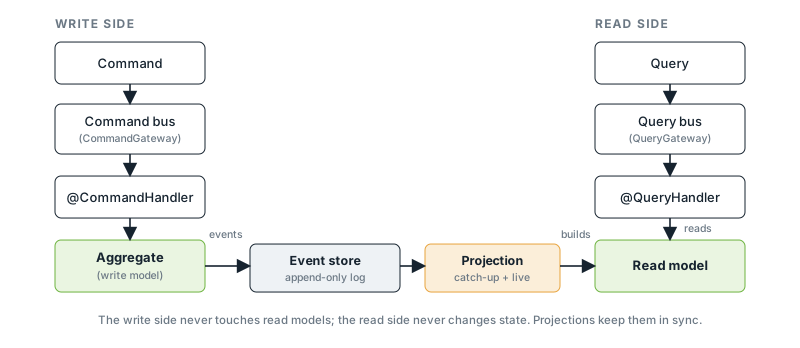
CQRS (Command Query Responsibility Segregation) separates an application’s write side from its read side — commands change state through one model, queries read it through another model optimised for reads. The read models are kept in sync by projecting changes from the write side.
Spring DDD’s CQRS layer is a command bus, a query bus, and a projection dispatch and catch-up runtime. It is independent of event sourcing: it works with any persistence backend (JPA, plain JDBC, in-memory) and combines with event sourcing via the bridge starter when needed.
Dependency
The CQRS layer ships with whichever projection-store starter you choose:
// build.gradle.kts — JSON read models over JDBC (no Hibernate)
implementation("de.dwittkoetter:spring-ddd-starter-cqrs-jdbc:0.0.1-SNAPSHOT")
For JPA-@Entity read models, use spring-ddd-starter-cqrs-jpa instead.
Either starter pulls in the command bus, query bus, and projection dispatch runtime from
spring-ddd-cqrs.
The universal bundles spring-ddd-starter-jdbc and spring-ddd-starter-jpa already include the
CQRS layer (and combine it with event sourcing via the bridge starter).
See Choosing your starters.
Configuration
The spring.ddd.cqrs.enabled property is the master switch for the whole layer.
Setting it to false disables the entire CQRS infrastructure.
The command pipeline (spring.ddd.cqrs.command.enabled) and query pipeline (spring.ddd.cqrs.query.enabled)
are subordinate sub-switches that default to true and only take effect when the master switch is enabled;
the projection runtime is likewise subordinate to the master switch.
For the full property reference, see the Appendix → Configuration Properties.
In this section
- Commands
-
Defining commands and handlers, dispatching via
CommandGateway, the transaction model, and the auto-managed aggregate command pattern. - Queries
-
Defining queries and query handlers,
QueryGateway, and return-type resolution. - Projections
-
Read-model projections, catch-up and live dispatch, error policies, and projection repositories.
| Commands and queries can also be routed to an external system instead of a local handler, selected by message type and without changing call sites. Routing is a cross-cutting messaging concern rather than a CQRS-only one — see Routing. |